
The Library
These are mostly titles that I have read in the past few years.
I plead guilty to being mostly history and philosophy, but there is variety. I select them completely on what sounds interesting to me at the time.
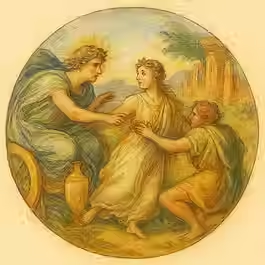
The Metamorphoses by Ovid
Ovid’s "Metamorphoses" is one of the great treasure houses of Western storytelling — a vast collection of myths, all revolving around the idea of change. Gods become animals, humans become trees or stars, landscapes shift, identities dissolve and reform. What’s astonishing is how familiar so many of these stories still are: Apollo and Daphne, Pygmalion, Orpheus and Eurydice, Perseus and Andromeda, Narcissus and Echo. They remain powerful because they speak to something permanent in human experience — desire, loss, transformation, the longing to escape or transcend the limits of the self.
Reading Ovid today, you feel how deeply his imagination has shaped our own. Painters, poets, composers, and playwrights have returned to these stories for centuries.
What makes the poem endure is its combination of elegance and wildness. Ovid writes with wit, irony, and a lightness of touch, but beneath the surface is a deep understanding of how unstable life can be — how quickly fortune turns, how fragile identity is, how beauty and terror often coexist. "The Metamorphoses" is not just a compendium of myths; it’s a meditation on the inevitability of change, and on the stories we tell to make sense of it.
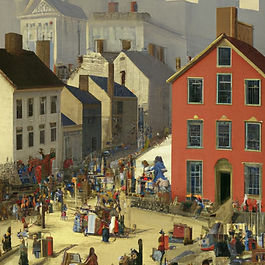
The Making of the Nation 1783-1860 by the Editors of American Heritage
This book comes from American Heritage, one of my earliest introductions to history. I read their hardcover editions when I was in elementary school, and the illustrations made a deep impression on me — not just decorative images, but full-page paintings, maps, and archival photographs that brought the past to life. The text was always informative, though you could sense the different voices of the various authors who contributed to each volume. That variety gave the series a distinctive texture: history told by many hands, but with a shared commitment to clarity and storytelling.
American Heritage itself has a long and distinguished history. The magazine was founded in 1947 by the American Association for State and Local History, and relaunched in 1949 as a broader publication for general readers. In 1954 it was transformed into the beautifully illustrated, hardcover, advertising free magazine that so many of us remember from childhood. Print publication ended in 2013, but the magazine was revived digitally in 2017 and continues today as one of the most respected voices in American historical writing.
"The Making of the Nation: 1783–1860"reflects everything that made American Heritage special. It covers the period between the end of the Revolution and the eve of the Civil War — a time of expansion, inventio, conflict, and political experimentation. The book moves through the creation of the Constitution, the rise of the early republic, the growth of the frontier, the tensions over slavery, and the emergence of a distinctly American culture. And, true to the magazine’s tradition, it does so with generous illustrations that help a young reader (or an older one) feel the texture of the era.
Looking back, it’s easy to see why these volumes mattered so much to me. They made history accessible without simplifying it, and they taught me that the past is not a distant abstraction, but a story filled with people, choices, and consequences. This book, like the others in the series, helped form the foundation of my lifelong interest in history — an interest that still shapes my reading, my writing, and even the way I think about my life today.
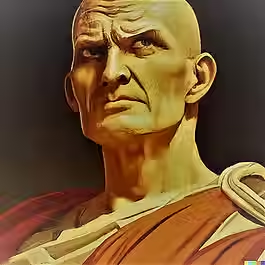
The Landmark Julius Caesar by Gaius Julius Caesar and Others
This volume is one of the strongest in the Landmark Series, not only because it includes Caesar’s "Commentaries on the Gallic War," but because it gathers the additional accounts written by his officers describing the campaigns in Egypt, Africa, and Spain. Taken together, they give a full picture of Caesar as a military man — not just the polished statesman of later legend, but the commander who marched, fought, and endured alongside his troops.
As always with the Landmark editions, the maps and annotations are extraordinary. Every river, hill, and fortified town is precisely located, so you can follow Caesar’s movements with complete clarity. It turns what could be a dense military chronicle into a vivid, almost tactile experience. You see how he used terrain, how he moved faster than his enemies expected, how he improvised when outnumbered, and how he kept his army together through sheer force of will.
What stands out is how often Caesar faced superior numbers — and how rarely that mattered. He was never out generaled. His speed, decisiveness, and ability to read a battlefield were unmatched. And like Alexander, he led from the front. Ancient sources describe him wearing a red cloak so his men could always see him in the chaos of battle. That detail alone tells you why they followed him so fiercely.
The Landmark edition brings all of this into focus. It’s not just a record of campaigns; it’s a portrait of a man whose ambition, brilliance, and audacity reshaped the Roman world. Reading these accounts together, with the support of the Landmark maps and notes, gives you a sense of Caesar’s military genius that no single text could provide.