The Library
These are mostly titles that I have read in the past few years.
I plead guilty to being mostly history and philosophy, but there is variety. I select them completely on what sounds interesting to me at the time.

Letters of Seneca
Who would think that a collection of letters written two thousand years ago would still be worth reading? Yet Seneca’s Letters feel startlingly alive. Insights are everywhere — clear, direct, and rooted in a genuine attempt to understand how a person should live. He thought about these questions with a seriousness that seems almost lost in the modern world. Maybe that’s why I’m so drawn to him and the other Stoics, and even to the Taoist tradition: they all treat philosophy as a guide to living, not an academic exercise. Returning to Seneca reminds me that these questions are ancient, but never outdated.

Le Morte d’Arthur
I’ve always been drawn to the Arthur story, as so many people are, and I wanted to go back to the original source — or as close to it as we can get. First printed by William Caxton in 1485, it stands as one of the earliest major works ever published in English. Caxton not only printed it but shaped it, editing and organizing Mallory’s manuscript into the form we know today. Mallory himself gathered centuries of legends into a single narrative, creating the version of Arthur that later writers, artists, and filmmakers inherited. You have to really want it — the language is dense and the world remote — but its place in literary history is secure, and it’s worth reading for that alone.
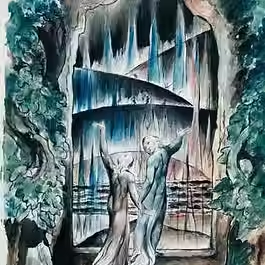
Illustrations of The Divine Comedy by William Blake
This is primarily a visual book, and a remarkable one. My edition — a TASCHEN volume, beautifully produced as they always are — shows just how powerfully Blake could visualize Dante’s world. It doesn’t cover the text itself, but the images are extraordinary: inventive, unsettling, and full of Blake’s distinctive energy. Seeing all the illustrations together gives a real sense of his ability to inhabit and reinterpret Dante’s vision.